
Materials
Choosing blasting media
The media is the tool. Get it wrong and you either spend all day not removing the coating, or you remove the coating along with the surface underneath. Here is what each one does.
If you read one thing
Recycled crushed glass handles most paint, rust and anti-foul work and is our default. Garnet is harder and faster for heavy mill scale and specified profiles. Soda is the only genuinely non-abrasive option, for chrome, alloy and heritage. Match the media hardness to the substrate hardness, never the other way around.
Why media choice decides the job
Pressure gets the attention, but media does the work. Two operators at identical pressure with different abrasives will produce completely different results — one strips clean in a single pass, the other polishes the paint or gouges the brick.
Three properties matter: hardness (can it cut the coating without cutting the substrate), shape (angular media cuts, round media peens), and grade (particle size, which controls both removal rate and the profile left behind).
Hardness, in one number
The Mohs scale is a rough but useful guide. Your substrate has a hardness. Your media has a hardness. If the media is significantly harder than the substrate, it will cut into it.
| Material | Mohs | Note |
|---|---|---|
| Sodium bicarbonate (soda) | 2.5 | Softer than aluminium — will not cut metal |
| Aluminium | 2.5–3 | Substrate |
| Walnut shell | 3–4 | Organic, non-destructive |
| Mild steel | 4–4.5 | Substrate |
| Copper slag | 6–7 | Aggressive, single use |
| Recycled crushed glass | 6–7 | The all-rounder |
| Hardened steel grit | 7–8 | Heavy industrial only |
| Garnet | 7.5–8 | Fast, clean, reusable |
Recycled crushed glass
What it is: post-consumer bottle glass, crushed and graded. Made in Australia, including in WA.
What it does: angular, sharp, cuts paint, rust, anti-foul and coatings efficiently at moderate pressure. Leaves a good clean anchor profile. Contains no free silica, which is the reason it replaced sand.
Where it suits: almost everything. Automotive panel, boat hulls, structural steel, gates, trailers, machinery, brickwork at reduced pressure. It is our default and covers perhaps 70% of the jobs we run.
Watch for: it fractures on impact, so it is largely single-use in a mobile setup. Cheap enough that this rarely matters.
Garnet
What it is: a naturally occurring hard mineral, mined in Australia — much of the world's supply comes out of WA.
What it does: harder and denser than glass, so it cuts faster and holds up better. Produces a consistent, well-defined profile, which is why coating specifications so often name it. Low dust generation even dry, and recyclable several times over in a controlled setup.
Where it suits: heavy mill scale, thick industrial coatings, tank work, structural steel with a specified profile, and anywhere a coating datasheet dictates the abrasive.
Watch for: more expensive per tonne than glass. Too aggressive for thin panel, soft masonry or timber.
Sodium bicarbonate (soda blasting)
What it is: a specific crystalline grade of baking soda.
What it does: the crystals shatter on impact, and that shattering energy lifts the coating. Because soda is softer than aluminium, it physically cannot cut metal — the trade-offs are set out in soda blasting vs sandblasting. It removes the paint and stops at the substrate.
Where it suits: chrome, polished alloy, aluminium boat hulls, engine bays, delicate heritage work, fibreglass, and food-industry equipment where residue must be non-toxic. Also degreases as it goes.
Watch for: slow, expensive, and it leaves no anchor profile — so if the surface is being repainted, it will need a separate keying step. Soda residue also inhibits some coatings and must be washed off thoroughly. Alkaline runoff kills plants; containment is non-negotiable near gardens.
Copper and coal slag
What it is: a by-product of copper or coal-fired power generation, crushed and graded.
What it does: cheap, sharp and aggressive. Cuts fast on heavy industrial work.
Where it suits: large-scale industrial dry blasting where cost per tonne is the driver.
Watch for: generates significant dust, breaks down quickly, single use, and can contain trace heavy metals that complicate disposal. We rarely reach for it.
Steel shot and grit
What it is: hardened steel particles — round shot or angular grit.
What it does: shot peens and cleans without cutting deep; grit cuts hard and leaves a deep, sharp profile. Highly recyclable, which is why it dominates fixed blast rooms and wheelabrators.
Where it suits: heavy fabrication, foundry work, shipyard plate in a recovery-equipped facility.
Watch for: ferrous, so it embeds in the surface and will rust. Useless on stainless or alloy. Needs recovery equipment to be economic, which makes it a workshop medium rather than a mobile one.
Walnut shell and corn cob
What they are: crushed agricultural by-products.
What they do: very gentle cleaning that removes soot, grime and light coating without touching the substrate at all.
Where they suit: log cabins, heritage timber, cleaning carbon off engine components, and jobs where absolutely no substrate loss is acceptable.
Watch for: will not touch a bonded coating. Absorbs moisture, so poorly suited to wet blasting.
Grade matters as much as material
Every media comes in grades — coarse, medium, fine. Coarse cuts faster and leaves a deeper profile. Fine cuts slower, leaves a shallower profile and gives more control.
A fine glass at low pressure and a coarse glass at high pressure are, practically speaking, two different tools. This is why we can strip paint off a heritage brick wall and blast mill scale off a tank shell using the same abrasive material.
Matching media to substrate
| Substrate | First choice | Avoid |
|---|---|---|
| Car panel, thin sheet steel | Fine recycled glass, wet | Steel grit, coarse garnet |
| Structural steel, mill scale | Garnet, medium–coarse | Soda, walnut |
| Steel boat hull, anti-foul | Recycled glass, wet | Steel grit (embeds and rusts) |
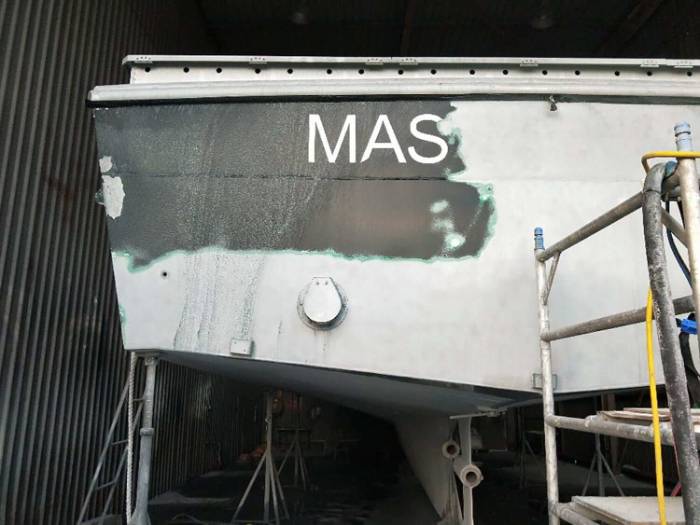
| Aluminium hull or alloy | Soda, or fine glass at low pressure | Anything ferrous, coarse garnet |
| Chrome and polished alloy | Soda | All hard abrasives |
| Brick, render, limestone | Fine glass, wet, low pressure | Garnet, steel grit, high pressure |
| Hardwood timber | Fine glass, very low pressure | Coarse anything |
| Heritage masonry or soft stone | Soda or walnut shell | Every hard abrasive |
| Concrete, exposing aggregate | Coarse glass or garnet | Soda (no cut) |
| Fibreglass | Soda or very fine glass, low pressure | Garnet, steel grit |
If your coating datasheet specifies an abrasive or a profile, that overrides this table every time. See surface profile and prep standards.
Reuse and disposal
In a mobile setup, most media is single-pass. It is not the abrasive that determines how the waste is handled — it is what came off the surface. Recycled glass is inert; recycled glass carrying lead paint or anti-foul biocides is regulated waste.
We collect spent media on every job and dispose of it based on the coating removed. Nothing gets left in your yard, and nothing goes near a stormwater drain.
Common questions
Media questions we get
What media do you use as standard?
Recycled crushed glass, graded to suit the job. It is angular, silica-free, made in Australia and handles the large majority of paint, rust and anti-foul work. We switch to garnet for heavy mill scale or specified profiles, and soda for chrome, alloy and heritage work.
Will soda blasting remove paint from my car?
It will lift paint without touching the metal, which makes it excellent for chrome and alloy trim. But it leaves no anchor profile, so a repaint needs a separate keying step, and soda residue must be washed off thoroughly or it will interfere with the new coating. For a full body strip we normally use fine glass, wet.
Can blasting media damage brickwork?
Yes, if it is too hard or the pressure is too high. Garnet on soft heritage brick will erode the fired face and leave the wall permanently rough. We use fine glass at low pressure with water, and always run a test patch on masonry first.
Do you reuse the media?
In a mobile wet setup, generally no — recycled glass fractures on impact and comes back mixed with coating debris. Garnet and steel grit are recyclable, but that needs recovery equipment and is a fixed-facility arrangement rather than an on-site one.
Does the media choice change the price?
Somewhat. Garnet costs more per tonne than recycled glass, and soda is dearer again and slower. On most domestic jobs the difference is small next to labour and setup. On a large specified industrial job, the media line item is real and we itemise it.
Keep reading
Next in the knowledge hub
Not sure what your surface can take?
We test-patch anything unusual before committing. Send a photo and we will tell you the media we would use.
Written from our own jobs across Perth and WA · Last updated 20 August 2026