Line Marking Removal sandblasting · Perth & WA
Line Marking Removal Perth
Thermoplastic, paint and cold-applied markings taken off asphalt and concrete — without the scarring that grinding leaves behind.
In short
Blasting removes markings without gouging the pavement. Grinding leaves a scar that re-marks poorly and reads as a ghost line forever; wet abrasive takes the marking and leaves the surface intact.
What comes off
Car park bays, arrows, hatching, disabled bays, crossings, road lines and stencilled text. Wet media lifts the marking off the surface rather than cutting a trench through it, so the ghost line and the grinder scar you get from mechanical removal are avoided.
Most of this work happens after hours. Car parks and access roads reopen the same shift, with no dust plume drifting across the site while we work.


Why not grind it?
A grinder removes the marking and a few millimetres of pavement with it. What is left is a shallow trench that collects water, reads as a shadow under low sun, and gives the new marking an uneven bed to sit on.
Blasting works on the marking itself. On asphalt the aggregate is left proud and undamaged; on concrete the surface keeps its texture.
Car parks, roads and crossings
Retail and commercial car parks being re-bayed, roads where an alignment has changed, pedestrian crossings, loading zones and airside markings. Where a layout is changing we can remove selectively so only the lines being moved come up.
Working after hours
Trading hours and traffic usually decide the schedule, not us. We work nights and weekends, stage the work so sections reopen progressively, and clear the spent media and marking debris before we leave.
How the job runs
Site look
Surface type, marking type, the layout coming next, and the access window available.
Set up
Traffic management as required, drains protected, capture placed for media and debris.
Blast
Marking removed line by line, pressure matched to asphalt or concrete.
Sweep and reopen
Debris and media collected, surface swept, area handed back ready for re-marking.
Car park, road and crossing are three different problems
Car parks and hardstands
Bay lines are usually chlorinated rubber or acrylic over asphalt or concrete, often several repaints deep. The aim is to take the marking off without cutting a trench where the line used to be — a ghost groove reads as clearly as the paint did, and it fills with dirt. Wet blasting lifts the coating and leaves the surface texture close to what is around it.
Roads and thermoplastic
Thermoplastic is a different material: thick, hard and fused to the surface. It takes a slower, more aggressive approach than paint, and on aged asphalt the bitumen underneath is softer than the marking on top, which is exactly why grinders scar. Traffic management is part of the job and needs to be in the plan and the price.
Crossings and coloured surfacing
Pedestrian crossings, bike lanes and coloured surface treatments sit in high-visibility locations where a poor removal is obvious to everyone who uses them. These get the most conservative pressure and the most test work before committing.
Dust, water and the site around you
Removal on a live site means containing what comes off. Wet blasting keeps the residue at the base of the work instead of drifting across parked cars and shopfronts, and spent material is collected. Preparing your site lists what we need in place before arrival.
Recent jobs
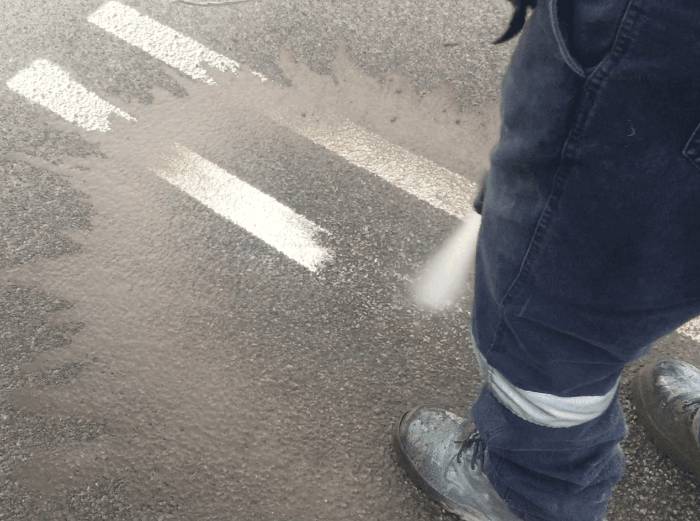
Real work from around Perth and regional WA. Every photo on this page is one of ours.

Where we do this work
Mobile across the Perth metro at our standard rate, regional WA in batched trips. See before and after photos of this work.
Common questions
Line Marking Removal sandblasting — your questions answered
Will it damage the asphalt?
No. Blasting works on the marking rather than the pavement, so the aggregate is left proud and intact. That is the main reason clients move away from grinding.
Can you remove only some of the lines?
Yes. Where a layout is changing we remove selectively, so only the bays and lines being moved come up and the rest stay as they are.
Can you work outside trading hours?
Yes — nights and weekends are normal for car park and road work. We stage the job so sections reopen progressively where the site needs it.
Will removing the lines leave a ghost mark?
Done at the right pressure, the marking comes off without cutting a groove. Some shadowing can remain where the paint protected the surface from years of UV and wear — that is the surface around it having aged, not damage from the removal.
Can you remove thermoplastic markings?
Yes. Thermoplastic is thicker and harder than paint, so it is slower going and needs a more aggressive setup, but it comes off without the surface scarring a grinder leaves.
Do you handle traffic management?
We plan around it and can work with your traffic management contractor. For road and public car park work, tell us at quote stage who is arranging it, because the control setup usually dictates the working window.
What has to be in place before removal starts
Most delays on removal jobs are access and approvals, not the work itself.
- Traffic management or car park closure arranged, with the working window confirmed
- Vehicles cleared from the bays being worked, and adjacent vehicles protected
- Confirmation of what is coming off: paint, thermoplastic, or coloured surface treatment
- Agreement on the finish — full removal, or removal to the point where new marking can go over it
- Somewhere for the spent media and removed coating to be collected
Related services and areas
Concrete exposure
Exposed-aggregate finishes for driveways, patios and feature slabs.
Construction sandblasting
Brick, concrete, render and timber stripped back on site.
Sandblasting Perth
Coverage, travel and access across the Perth metro area.
Last updated 20 August 2026