Abrasive blasting explained
What Is Abrasive Blasting?
The technical name for the whole family of blasting processes — dry, wet, soda and vapour — and the term coating specifications are written in.
The short answer
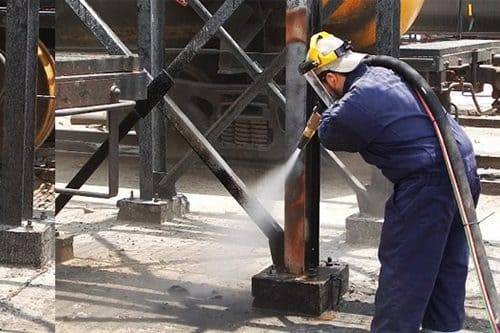
Abrasive blasting is the controlled removal of coatings, corrosion and contamination by firing abrasive media at a surface under compressed air, in order to reach a specified cleanliness and surface profile before coating. "Sandblasting" is the same process in everyday language; abrasive blasting is the term your coating spec will use.
The process, in order
Compressed air carries metered abrasive down a hose to a nozzle. Nozzle size, air pressure, abrasive type and abrasive grade together decide how hard the surface is hit and how much profile is left behind. Change any one of them and the result changes.
That controllability is the point. The same rig can take mill scale off structural steel and lift lime wash off heritage brick, because pressure and media are set to the substrate rather than the operator’s habit.
Cleanliness and profile
Coating systems do not ask for "clean". They ask for a stated cleanliness — how much coating, rust and contamination may remain — and a stated profile, the peak-to-valley texture the primer keys into. Get the profile wrong in either direction and the system underperforms: too smooth and it has nothing to grip, too coarse and the peaks read through thin films.
We blast to the standard your spec names and hand over photos of the prepared surface. Our guide to profile and prep standards explains how the grades work.
The four setups you will be quoted
Dry abrasive blasting — abrasive fired dry. Fastest and most aggressive, ideal for mill scale, heavy industrial coatings and tank interiors, but it throws a plume and needs containment or an enclosure.
Wet abrasive blasting — water injected at the nozzle. Almost no airborne dust and a cool surface, which is what makes it viable on occupied sites and thin panel.
Soda blasting — sodium bicarbonate, non-destructive. Strips coating without cutting the substrate, so it suits alloy, gelcoat, timber and anything you cannot afford to profile.
Vapour or slurry blasting — a fine media-and-water slurry for finish-critical work where the surface must be cleaned rather than cut.
Which one your job needs
Three questions usually settle it. What is the substrate, and can it tolerate profile? What is the environment — occupied, live plant, boatyard, suburban street? And what coating is going on afterwards, to what standard?
Because we run both wet and dry, we answer those questions with the job in front of us instead of selling the one setup we happen to own. Wet versus dry blasting sets the trade-offs side by side.
Where abrasive blasting is used
Structural steel and fabrication, mining plant and attachments, marine hulls and running gear, transport fleets and rolling stock, agricultural tanks and machinery, masonry and concrete, automotive panels and chassis, line marking, graffiti and fire damage. The services list breaks it down by industry.
Common questions
Abrasive blasting — your questions answered
Is abrasive blasting the same as sandblasting?
Yes. Abrasive blasting is the technical term used in coating specifications and standards; sandblasting is the same process in everyday language. Neither normally involves sand — garnet is the common abrasive in WA.
What abrasive media do you use?
Garnet as the default, because it cuts fast, grades finely or coarsely and is silica-free. Soda for non-destructive stripping, glass for finish-sensitive surfaces, and heavier abrasives for mill scale and thick industrial coatings.
Can you blast to a nominated standard?
Yes. Tell us the cleanliness and profile your coating system requires and we will blast to it, then issue photos and a description of the finish for your QA file.
Does abrasive blasting remove metal?
It removes a very small amount of substrate along with the coating — that is what creates the profile. On thin or already-pitted steel we back the pressure off, and on surfaces that cannot be profiled at all we use soda instead.
Do you work on live industrial sites?
Yes, working to your permit system — isolations, hot work, confined space and drain protection. Containment is set before the nozzle opens so adjacent crews and equipment are unaffected.
Written from our own jobs across Perth and WA · Last updated 20 August 2026